


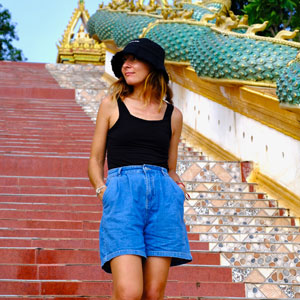
Decidedly, 2020 will remain a special year in every respect. While many would already like to celebrate Christmas so that they can move on to other things, I still remember a beautiful month of July, opening my eyes wide to marvel at Portugal’s landscapes and cultural riches.
Every year, for as long as I’ve known my Amore, the big vacations have meant long-distance travel, more than 5 hours’ flight from France. So when the ban on traveling outside Europe was imposed on us, we had to change our usual plans. Like many people, we could have said to ourselves “let’s go this year, let’s rediscover France”, but after the months of confinement spent in our new apartment, the urge to get back on the plane to land on foreign soil and drown in another culture with a different language was too strong.
Initially, Italy was on the agenda. Amore and I had never been to Puglia. Sun, burrata, pasta and pizza – our mouths were already watering! But that wasn’t counting EasyJet’s mass cancellations, barely a month before our departure.
Back to square one. Where to go? Covid-19 is still around and circulating… Come on, we’re back on flights from Nantes… and at bargain prices… 3 destinations operated by Volotea are available to us: Croatia, Portugal or Sardinia.
On second thought, we’re tempted by Portugal. Amore has never been to the Algarve yet, and neither have I. I’m in! And after 3 weeks there, it’s a choice I have absolutely no regrets about – quite the contrary! It’s a destination I’d do again without hesitation, at other times of the year for hiking or surfing sessions.
Preparing your trip and practical information
- Airline company for Nantes / Faro: Volotea
- Ideal times to visit Portugal: April to October, but beware of summer, when there are many tourists (except this year! #veinards).
- What to pack: It depends on the season, but in general, bring sun cream and aftershave ;), a pair of sunglasses and a hat. If you can, bring an umbrella, essential on Portuguese beaches. If you have one, bring your wetsuit for surfing, bodyboarding or longe côte, as well as waterproof shoes.
- Water temperature: 20 to 24° in the Algarve, 18 to 20° on the west coast
- Time difference: 1 hour less than in France
- Currency and standard of living: euro, and life is much cheaper than in France (beer at €1.50!!).
- Documents: Identity card or passport
- Gastronomy: On the savory side, try cataplana, a kind of fish tagine, and bacalhau: cod, an inseparable part of Portuguese cuisine. On the sweet side, indulge in pastéis de nata, a kind of flan. For refreshment, try the famous red or white Porto and local beers such as Sagres or super bock.
- What souvenir to bring back to the family: cork objects (you can admire cork-producing trees along the way) or magnets featuring the famous azulejos…
- Budget: approx. 1,200 euros per person (including car rental) for a 3-week road trip (including 9 days of home exchange)
- Car rental: useful and affordable (approx. 350 euros for 3 weeks). Driving is similar to in France.
- On the subject of rentals: at Faro airport, you’ll find “classic” rentals outside. For low-cost rentals, go to parking lot P4, where shuttles from each rental company will take you to the agencies located outside the airport. We booked our car with Auto Rent directly online. We just added the box for Portugal’s freeways (about 20 euros extra). Practical for the journeys we made, and it avoids nasty surprises if you take the wrong road. All in all, we spent around 80 euros on freeways for our 3-week stay.
- One last thing about car rental: In many European countries, our credit cards are a problem. So remember to ask your banker for a card with “credit” written on it rather than “debit”, otherwise you’re in for some nasty surprises 🙁
From Faro to Sagres, discover Portugal’s southernmost region: the Algarve
Before leaving, I took absolutely no time whatsoever to research the region. It was only when I started reading the Guide du Routard on the plane that I discovered that the Algarve was renowned for its magnificent beaches and surf spots. I thought it would be cool to try surfing lessons again with my darling’s son, as we had done in Bali. In any case, I’d never imagined that in this part of Portugal I’d find such incredibly colorful cliffs and colorful white fishing villages overlooking sandy coves. I really enjoyed this lifestyle, where the pace is particularly cool, where locals, tourists and young thrill-seekers meet in converted vans parked as close to the coast as possible.
FARO, the capital of the Algarve
Arriving in Faro gives you a foretaste of your vacation, as the airport is located by the sea. Which is funny, because you get the impression that the plane is about to ditch!
From the airport, it’s easy to get to the center of Faro, as a bus (no. 16, 2.50 per ticket) drops you off at the bus station, just a few minutes’ walk from town. However, be careful not to take the bus to the playa.
Les portugais ne sont pas les plus ponctuels donc ne vous étonnez pas d’attendre parfois 10 à 15 min de plus que l’horaire annoncé sur le panneau d’affichage 😉
From the terminal, it was a ten-minute walk to our guest-house. Super convenient when your flight is scheduled for late in the evening. I can easily recommend the Casa tradicional algarvia where we stayed for 3 days and 2 nights, as the value for money and the location were very good in my opinion (€33 per night, but beware of rates during the COVID-19 period). It was a room, admittedly rustic and basic, for 3 people located in a sort of mansion. We shared the 2 bathrooms and the kitchen, but I particularly appreciated the terrace on the roof of the hotel, with a breathtaking view over the Faro marina. Ideal for sunbathing or family meals.

After our first night on Portuguese soil, we set off on foot for a stroll around the city. Faro is very pretty. Like the rest of the country, I found Faro to be a joyful mix, reminding me at once of the Camargue, Morocco, or countries like Cuba, with its pretty, colorful cobbled streets, sometimes decrepit facades and flowering trees. Life here seems calm, peaceful and authentic, without tourists. Look up and you’ll discover the intoxicating scent of orange trees and see storks nestling on rooftops everywhere!
Stop by San Antonio for a spot of shopping or enjoy an ice cream on the Marina 🙂


On day 2, we headed for the Ria Formosa lagoon. We chose to spend the day on theIlha Deserta (Ilha da Barreta).
There are 2 ways to get there: by ferry, which takes 45 minutes and costs 10 euros each way, or by speedboat, which takes 15 minutes and costs 20 euros each way. Personally, when we’re on vacation, we’re in no hurry 🙂 On the contrary, the crossing allows us to take time to admire the view and read a little history about the ria.
We really enjoyed this island, with its duckboard paths, translucent water and restaurant where you can go to the toilet and freshen up. There’s virtually no shade on the island, so be sure to bring a parasol to protect yourself from the sun, or rent one on the beach, otherwise beware of sunburn and sunstroke.


It wasn’t until the third day that we picked up our rental car at the airport. We had no use for it before.
Before heading west from Faro, pay a visit to Loulé, for its outlet and its little azulejo chapel: the capela de Sao Lourenço 🙂

My favorites in the Algarve
-
Tavira: for a bucolic stroll
This is undoubtedly one of the Algarve towns that has best preserved its southern style and authenticity. You’ll enjoy crossing its pretty Roman bridge, strolling along the river that runs through it and observing the many traditional 4-sided roofs. A stop at the gelatarias Delizia for a refreshing homemade ice cream is a must 🙂


-
Praia da Marinha and Praia da Falésia: my two prettiest beaches in the Algarve
In this region, it’s hard to rank the prettiest beaches, because there are so many! Each one has its own particularities, more or less easy to access, with waves for surfers, with services nearby (toilets, bar, showers etc…).
So, to sum up, if I had to choose just two, they were above all the ones that made me go WAOUH!!! when I saw them. And for Praia da Marinha and Praia da Falésia, that’s really what happened. Without even putting my towel down on the fine sand, I was already overwhelmed by the beauty of the landscape before my eyes.
Praia da Marinha first of all. Located in Lagoa, we were very lucky when we arrived at the parking lot, as a space opened up right in front of us. So we were able to park the car in the shade. After admiring the scenery, we took the long staircase down to the beach.
The view from below is breathtaking. We’re surrounded by warm-toned, cracked limestone cliffs, with a wide variety of rock formations: arches, caves, reefs and chasms. The area is ideal for snorkelling. It’s easy to spend the day here, having prepared a picnic beforehand. You can have lunch at the top of the cliff or directly on the beach, in which case you’ll need to bring your own umbrella or rent one.


Praia da Falésia next. Located in Albufeira, the beach stretches for almost 6 km, with a succession of high cliffs in strong tones, sometimes ochre and almost red, sometimes white and sandy, creating a constant play of colors against the green areas of umbrella pines that overhang them. It is the wear and tear of this rock that feeds the beach, providing its sand. Small pyramids of sand can be seen at the base of the cliffs. Some areas of the beach are very quiet, just a short walk away. Depending on the time of day, the colors vary and it’s a delight to observe this natural environment.


-
Lagos and Sagres: fall in love with surfing!
If there’s one city that charmed me for so many reasons, it’s Lagos. No wonder we went there for the first time in the 1st week, and came back at the end of our stay.
The town offers everything you need for a great vacation, with a less touristy atmosphere than towns like Albufeira, for example.
If I can give you any advice, it’s to find a nice place to stay in the area. For the last 3 days of our trip, we found a very nice apartment with a swimming pool and a gym on the roof 🙂
Afterwards, a wide range of activities are on offer.
For those who want to try their hand at surfing, we tried out ” the surf experience” school. We really enjoyed our day, and if I were younger, I’d have loved to have taken a week of lessons there. One-day lessons cost 60 euros. You meet at 8.30 a.m. in front of the school, then take the minibus to the coolest spots with your equipment (wetsuit and boards). The day we went out, they took us to the Praia da Arrifana, a real surf spot. There were just a dozen of us, but we had 3 instructors who divided us up by level. After a briefing, we jumped into the water for a first session lasting around 1h30. We then took a break for lunch. The school’s cook is top-notch. We each had a box with a choice of vegetarian or chicken. After lunch, we quietly returned to our boards for a second session. We were pretty worn out from our day, but what a kick !!!! And a feeling of having made good progress… Hence the desire to come back here to continue improving 🙂
If surfing doesn’t appeal, you can rent a kayak on Batata beach. There’s a rental company on the beach. Much better than group excursions 😉 Afterwards, you can take a leisurely stroll along the coast, admiring the scenery and caves all the way to praia do camilo.
In the evening on Lagos, I recommend watching the sunset over the Ponta da piedade before returning to the city center for dinner.


For a good cataplana, a kind of fish tagine, I recommend the REIS restaurant. The one with shrimp and monkfish is perfect!

And for a romantic meal, I recommend this restaurant: Luca’s rooftop Restaurant. Located on the roof of the Carvi Beach Hotel on the beach Dona Ana beach, it’s the ideal place to sample the finest local dishes, while listening to traditional Portuguese Fado music on certain evenings.
Nearby, you can also visit the Lagos Zoo. We did it because my darling’s son wants to become an animal caretaker, and it had a good rating on Trip Advisor. I think it’s a great thing to do, especially if you’re a family with young children. I particularly liked the fact that I could enjoy a swimming pool right next to the African penguins! With the transparent windows, you can admire them almost right in front of you! Very sheltered from the sun, as well as being a very well-maintained zoo, I found the visit very enjoyable.


Sagres also appealed to me, as it’s “the place to be” for surfers. However, prices are higher than in Lagos. So if you’re with your family, Lagos is the place to be. But if you’re with friends on a road trip in search of the best spot, and you like surfing in a wild environment, then this is the spot for you!
Sagres is a small seaside town surrounded by nature. Quiet, secluded coves, great beaches, some nice rollers and pointbreaks all year round. No wonder surfers who want to take advantage of the pleasant climate and Atlantic winds stop here.
All kinds of nature sports can be practised here.
Good to know For beginners, the Algarve and the Sagres surf spots are particularly well suited. The water is good, the beaches beautiful and the waves not too nasty. Several surf schools offer lessons and surfboard rentals in the town.
We particularly enjoyed the Praia do Tonel for a cool surfing session. For around 30 euros, you can rent a board and wetsuit on the beach, under the bar, and practice for around 2 hours, before enjoying a well-deserved smoothie or a doughnut on the beach for those with a sweet tooth.

For those with a good level, prefer Praia do Beliche: more technical, as the waves are hollow but close to the shore.
-
Carvoeiro and Algar Seco: to admire the scenery and the reckless young locals
Impossible to miss if you’re in the area! One of my best memories after my surf sessions!
Start by visiting the small town of Carvoeiro. Then head for the Algar Seco natural monument. You can first take a walkway, known as the Carvoeiro Promenade. Built atop the cliffs, it offers a magnificent panoramic view.
Then descend to the craggy rocks and caves, sculpted over hundreds of years by the wind. Holes in the rocks give them the appearance of windows and balconies.


Then set your towels down on the algar seco cliff to admire the local “jumpers” leaping from the top of the cliffs, over 10 meters high.
It’s also possible to try Jumping at more reasonable heights, from 3 to 5 metres.
Be careful, if you go this way, bring good shoes or beach shoes, or even overalls, as the ground and rocks are very sharp and can easily be injured.
What I liked least about the Algarve
-
Portimao and Silves
These two cities aren’t totally devoid of interest, but compared with other places we’ve visited, I didn’t find any particular charm.
A stroll along the harbour is a nice way to spend some time after tasting the deliciously prepared canned fish in the Maria do Mar restaurant.


If I had to do it over again, I’d rather go through Olhao, which looks prettier and more typical. As I passed along the road, I did appreciate the stop in Ferragudo, with its white streets.

In Silves, in addition to its rich history and fascinating sites, you’ll appreciate its absolutely splendid setting, as it runs along the banks of the Rio Arade and lies at the foot of the hills of the Algarve countryside. Even so, I wasn’t really dazzled, at least not as much as some other places 😉

-
Benagil: overrated
People all over the Algarve talk about Benagil and its famous grotto. But what we forget to mention is that the beach is very small, and sometimes, when the currents are too strong, you can’t rent a paddle or a kayak, and the lifeguards won’t let you swim to them. As you can see, the place is overcrowded and, above all, there isn’t enough room for all the tourists who want to drop in. As a result, you spend hours looking for a parking space… only to end up frustrated if you can’t get to the cave.

Especially as you’ll be far from the only ones who want to get there: hello floods of boats going back and forth all day for excursions… everything we hate. That’s why we prefer to go right next door, to Praia do Carvoeiro, to explore the caves and rock formations, which I think are just as pretty as Benagil 😉
-
Albufeira: too touristy
Again, I’m not saying you shouldn’t visit Albufeira, as the old part of the town is not without its charms…., but you should know that this is the most touristy seaside resort in the Argarve, with its “thirsty street”: the rua Candido dos Reis, where young revellers come to get drunk and enjoy cheap beers, and its stores and restaurants for tourists… everything we hate 🙂 Here, on the other hand, you’ll find everything you need to have fun (jet-skiing, parasailing, boat trips, etc.). In fact, to find what you’re looking for, head for the Albufeira Marina, which offers corners for booking these attractions. The place is just too Instagrammable, with its colorful, Miami-style facades 🙂


If you feel like walking and exercising, you can get there on foot, but like San Francisco, the city is winding 🙂 Otherwise, if you’re feeling lazy, the best option is to take the famous tramway line 28, the Santa Justa Elevator or the Da Gloria Funicular, which is located in Restaurateurs Square.

-
The Chiado district
Rebuilt after the 1988 fire, the most important streets are Carmo, with the ruins of the church of the same name (which was not rebuilt in memory of the great earthquake), and Garret. This is the city’s “chic” and bohemian district, sometimes compared to our Parisian “Montmartre”.

-
The Bairro Alto district
On the São Roque hill, Bairro Alto is one of Lisbon’s oldest districts. Together with the Chiado district, it represents the new “trendy” face of the Portuguese capital. Quiet and family-friendly by day, this district becomes one of Lisboa’s liveliest spots by night.
In the steep cobbled streets, you can stop to photograph the old azulejo facades and historic monuments. You can also shop in young designers’ workshops and home decoration boutiques.
For a great view, head for the miradouro de São Pedro de Alcântara (Saint-Pierre d’Alcantara lookout).
If you’re feeling a little hungry, it’s time to head back down to the Mercado da Ribeira for a bite to eat at the Time Out Market.


After a good meal, there’s nothing better to digest than taking line 28 back to the Alfama district, to let yourself be rocked and admire the view.


For day 2, I suggest we start with the Belèm district.
-
Belém
This district is home to two imposing architectural monuments: the Hieronymites Monastery (which reminded me of Harry Potter’s Philosopher’s Stone!!), with its church and cloister, and the Belem Tower.
You can reach Belém from Praça do Comercio with tramway no. 15.


On the way back to the city, it’s also impossible not to stop and devour the Pastéis de Belém, for us the best in Lisbon, with powdered sugar and cinnamon to sprinkle on top 🙂 Pure delight!


Along the way, you may catch a glimpse of one of the murals by Artur Bordalo, aka Bordalo II. A street-art artist born in Lisbon in 1987. During his childhood, he lived between two worlds, one in which he observed his grandfather, the painter Real Bordalo, painting his watercolors, and the other in which he discovered the consequences of illegal graffiti.

To continue the street-art theme, let’s head for LX Factory.

This historic industrial complex is home to designer boutiques and original restaurants. A sort of “Darwin ecosystem” for Bordeaux, Camden Town in London, or Berlin’s FRIEDRICHSHAIN, it’s obviously my favorite part of our visit to the capital 😉
I loved the graffiti and the atmosphere, with its little designer boutiques, tattoo artists and cool restaurants!

I recommend the SHOWU boutique, which offers a lovely mix of carefully selected vintage pieces and made-in-Portugal creations 🙂 I’ve fallen for a few small pieces!


To continue with our shopping favorites, if you’re ever back in the city center, and if you like vintage, then I recommend a visit to POP CLOSET.
To round off your day, I recommend a visit to the BAIXA district, the most commercial area, with all its stores and quiet places to have a drink 🙂

Around Lisbon
-
SINTRA
The Serra de Sintra is a must for lovers of atypical villages with character. No wonder UNESCO has declared it a World Heritage Site.
A word of advice: go during the week and avoid weekends and Mondays, the busiest days for tourists. Also, try to arrive early, as parking can be very difficult. Ideally, as there are so many wonderful things to visit, plan to spend the night on site or nearby.
If you can, start by visiting the park and the Pena Palace, in the Sintra mountain range, as soon as it opens (9:00 am).
This palace is a must-see, as it looks so incredible and exuberant, sitting atop its rock. Make sure you get all the information you need beforehand (not like us!), as the security service can close the mountain to transport (including tourist buses and public transport) due to fire and weather risks, etc. (which was our case :().
However, if you’re brave, there is a footpath up there, but you need to know where it is. So I think the easiest thing to do is to pay for a guided tour. It’s much more comfortable and you learn a lot more with a guide.
For the record, it was in 1838 that Ferdinand II, King Consort of Queen Marie II, purchased the ruins of the monastery on the summit, the surrounding woods and the nearby Château des Maures, a total of 200 hectares, and initiated the construction of the road that would lead from Sintra to the Palace. Restoration of the old monastery (red buildings) began in 1840 and, around 1850, he decided to add a new palace (yellow buildings).
German Baron von Eschwege was commissioned to oversee the restoration and construction work.

Once you’ve made your way back down to Sintra’s town center, if you pass the town hall, you’ll immediately realize that the town’s architecture also benefits from a skilful blend of styles. As you continue towards the historic center, you’ll come across the“Palacio nacional de Sintra“, original and distinctive with its two gigantic conical chimneys.


The monument, dating from the late 14th century, has been the summer residence of many of Portugal’s kings. Each room is decorated differently with magnificent azulejos.
-
Estoril and Cascais in the footsteps of James Bond!
If you like the famous agent 007, you’ll love a trip to Cascais and Estoril. Although we didn’t do the former for lack of time, I’d recommend it, as the photos make it look really pretty.
Estoril, on the other hand, seduced us with its stroll along the beach, its huge “Casino Royale” (which starred in one of Ian Fleming’s novels) and its famous Hotel Palacio. As James Bond’s father would rightly say, “this is a great place to live, and even to die”. No wonder, then, to see so many imposing mansions and a clientele enjoying the retreat, the golf courses, the chic boutiques and the mild microclimate.
The city has retained its somewhat luxurious reputation, thanks to the many sporting events it hosts: the ATP Tennis Open and the Grand Prix auto-moto on the city’s circuit.
-
Fonte da telha beach
Fancy a lazy beach day less than an hour from Lisbon? Then head for the pretty beach of Fonta da Telha. It’s one of the most popular beaches in Lisbon as soon as the weather turns warm.

-
Further south, Setubal and the Serra da Arrabida natural park
If you have 3 weeks’ vacation like we do, you’ll have plenty of time to explore all the areas around Lisbon. Setubal and the parque natural da Serra da Arrabida offer an incredible view of the most beautiful natural landscapes in central Portugal.
Tree-lined hills, immense cliffs and picturesque beaches with crystal-clear water like the Saintes, it’s all there!
However, bear in mind that, like many popular spots, you’ll need to be patient… and enjoy the icy water! Compared with the Algarve, the contrast is striking and dampens the desire to swim 🙂

Before moving on to central Portugal, you can watch a video of our stay in and around Lisbon on my IGTV Instagram channel(subscribe 🙂)
Central Portugal, to discover UNESCO World Heritage sites
After the Algarve, Central Portugal is a real “coup de coeur” discovery, as the towns are so full of cultural wonders.
Here’s what we found out:
-
TOMAR and its Convento do Cristo
Overlooking the town is the monument for which it is famous. This 12th-century fortress originally belonged to the Knights Templar, then to the Order of Christ under the reign of Dom Dinis.
So don’t be surprised if a knight with the Templar symbol greets you as you enter the building 🙂
We were very lucky to be able to take the tour virtually on our own, without any tourists.
Practice : I recommend taking the package to visit the 3 monuments of Tomar, Batalha and Alcobaca (15 euros per person).
It’s hard to believe that this is a convent, given the architectural wealth of the period. On entering, you’d never expect to find 8 cloisters in succession, each more beautiful than the last and, above all, very well preserved.


After this first visit, before heading off to Batalha, we take advantage of the time to have a picnic in Fatima. This is our chance to visit Portugal’s “Lourdes”.
It was here that the Virgin Mary is said to have appeared. Since then, the vast meadow has rapidly become a pilgrimage destination for millions of visitors.
There is ample free parking all around the sanctuary. So it’s easy to park for a relaxing and/or spiritual moment.
I was very surprised to see pilgrims arriving at the chapel of the apparitions on their knees, following a marble path, shiny from being rubbed. In fact, it’s an old tradition to kneel around the churches, to make a promise to God or to thank him.


In Fatima, this tradition developed from the 1960s onwards, at a time of great poverty in Portugal during the wars of decolonization.

It’s impossible to pass through here without lighting a candle, under the huge soot-blackened hoods where hundreds of candles donated by pilgrims are constantly burning. An opportunity to say a prayer for all my loved ones.


-
BATALHA and its monastery
The tour then continues to Batalha and the Santa Maria da Vitoria monastery. Built in 1385 to commemorate the Portuguese victory over the Castilians at the battle of Aljubarrota, for two centuries the Dominican monastery was the major building site of the Portuguese monarchy, where an original national Gothic style was developed, deeply influenced by Manueline art, of which the royal cloister, a true masterpiece, is the perfect illustration. The monument is a UNESCO World Heritage Site.
I was particularly impressed by the detail and finesse of the work, which is classic Gothic in style.

Inside, the capelas imperfeitas, 7 chapels arranged around an octagonal hall, make up an unfinished ensemble. Despite this, the place is far from lacking in charm. In fact, I’d go so far as to call it a true masterpiece! With all those perfectly sculpted motifs.


-
ALCOBACA and its monastery
Of the three visits we made, I have to admit that this was the monument I liked least. Maybe we should start with this one! In any case, it made less of an impression on us than the other two. On the plus side, there’s the impressive 18th-century kitchen with its gigantic tiled fireplace.


On another positive note, it’s a great opportunity to drop into the town center for a pastry at ALCOA– calorific, but so good! The store proudly displays the many prizes it has won in competitions.

Stroll in the Alentejo
To conclude this article, I wanted to introduce you to these two towns in the Alentejo region, close to the Spanish border: Monsaraz and Evora . Monsaraz’s picturesque medieval landscape and low tourist numbers were a real surprise.
-
MONSARAZ
Perched on its hillside like an eagle’s nest with its ramparts, Monsaraz and its white houses immediately catch the eye. The town is an immediate invitation to explore, as it piques our curiosity. Off-limits to motorized traffic, it’s a lovely place to stroll through narrow streets and small squares.


For the record, the village was occupied by Romans, Barbarians and then Moors, and was considered impregnable. After numerous attempts by the Portuguese to reconquer the stronghold, Sancho II succeeded in driving out the Moors, with the help of the valiant Knights Templar in 1232. It was here, in gratitude for their help, that the Commandery of the New Order of Christ was established in 1319, following the dissolution of the Knights Templar. The castle was taken over by the Spanish when they invaded the Alentejo. It was during this period that Dinis I began construction of the Gothic courtyard and castle tower, based on a military model inherited from the Knights Templar. It was recovered by João I’s military forces when the Spanish retreated at the start of the War of Restoration.
-
EVORA
Like Monsaraz, Evora is a white city perched on its hillside, sheltered by its walls. A favorite residence of Portuguese sovereigns for many years, the capital of Alentejo has preserved its gentle way of life. Numerous monuments and churches are present to recall its history, such as the Sè, a Gothic cathedral, the largest in Portugal, and the Roman temple.

Entering, like Monsaraz, through an open gate in the medieval walls that still encircle it, always makes an impression. Once you’ve visited the main monuments, treat yourself to a stroll through the colorful streets, stopping to admire the squares and enjoy an ice cream.
This will be another opportunity to recognize the beauty of the azulejos on the facades and walls – adding the color blue to the palette of the white city hemmed in yellow.

Praça do Giraldo is Évora’s main square, decorated by a superb Renaissance fountain in Estremoz marble built in 1571.

Finally, you can follow our end of stay on my IGTV Instagram channel(subscribe 🙂)
I hope you’ve enjoyed this article about Portugal, and that it’s inspired you to take a flight and discover its landscapes and cultural riches. I remain at your entire disposal for any practical questions or advice you may require. Don’t hesitate to leave me comments, I’d love to hear from you 🙂
See you soon for new adventures!