


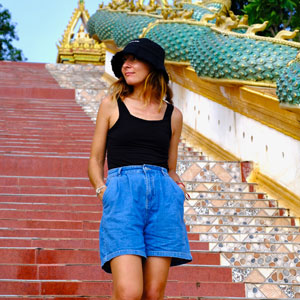
The first destination on the Asian continent during our round-the-world trip, Japan was everything I imagined it would be. A cultural slap in the face from many points of view.
It was a childhood dream to visit this country to admire the cherry blossoms and immerse myself in Japanese culture.
Club Dorothée generation, I remember my childhood and Wednesday afternoons spent watching cartoons from Asia: Jeanne et Serge, Nicky Larson, le collège fou fou fou, Ranma 1/2, the Knights of the Zodiac and the first Power rangers!
Kawaii” and gothic looks had always appealed to me, but living in the countryside it was impossible at the time to dare dress too eccentrically.
Finally being able to discover all this here really made me feel good and a pleasure to shoot. Especially since the Japanese love having their picture taken.
– You’ll find numerous goodie vending machines bearing the effigies of manga characters, and right next door sake containers or matcha tea stalls.
– You can worship in temples, and two streets away you can let loose in karaoke halls or temples of consumerism. You can worship in temples, and two blocks away you can let off steam in karaoke halls or temples of consumerism.
– Finally, you’ll see (except in rebellious Osaka) very few signs of affection and a great deal of shyness on the part of the Japanese. On the other hand, you won’t be surprised to see young girls dressed as soubrettes in the streets, selling “Maid Bars” or public baths where you have to go completely naked and where tattoos are forbidden.

But as I said in the title of this article, coming to Japan for a month during the cherry blossom season comes at a price. Especially just after the Covid period and the reopening of borders.
A victim of its own success, the country’s fares can make you sweat when compared to other Asian destinations such as South Korea, Thailand, Vietnam or Laos.
When you’re on a round-the-world trip and come from South America (with the exception of Chile), I can assure you that we had to be very careful with our expenses to avoid blowing our travel budget. We’ve had some great experiences, though, so I’d like to share our tips with you.
Tip 1: Plan your journey to save money
For our first visit to Japan, I decided to make the classic itinerary, i.e. the major cities. I’ve left out the Japanese Alps because the Kumano Kodo region seemed more authentic and spiritual.
We chose not to do a loop to avoid the return trip to Tokyo. Feel free to compare airfares to see what might be most economical for you, but it may be possible to fly out of Osaka.
So we landed and then set off for Tokyo for 8 days.

We then spent almost 3 days around Lake Kawaguchi-ko.

We continued on our way to Kyoto for another 4 days.

On the last day, we spent a day visiting Nara and in the evening took the train to Osaka.

We spent the night there and then headed down to Kii-Katsuura the following day to walk the kumano kodo trails for 3 days.

We then headed back up to Osaka for the night, and the next day we took the bus to Hiroshima to spend 2 1/2 days there.

Finally, we returned to Osaka and stayed there for 3 days before boarding the plane again for the rest of the trip.

I don’t regret this itinerary. I think we covered the essentials. On the other hand, now that we know how it’s possible to travel within the country, it makes me want to come back and go further afield.
If I had it to do over again, here’s what I might have done differently:
- I would have taken a night in Nara to do the whole park and temples, especially the one with the lanterns in the evening,
- In Tokyo, I would have visited Gotokuji temple, with its thousands of statues of lucky cats,
- On the island of Miyajima near Hiroshima, I would have visited the Daisho-in temple. Obviously we missed it, and it’s a pity it seemed so beautiful and free to visit,
- If budget had allowed, I would have booked a night in Koya-san to sleep in a shukubo (temple accommodation) and immerse myself in monastic life,
- I would have had our licenses translated into Japanese so I could rent a car and enjoy more of the hinterland.
2nd tip to avoid breaking the bank: book your accommodation well in advance
Booking your accommodation in advance is the key to getting good rates in the areas you want.
I was the one planning the trip. Like the other countries on the world tour, I had an idea of what I wanted to see and do, but I hadn’t booked anything in advance. I had booked the month before, and as you can imagine, at the height of the cherry blossom season, just after the announcement that the borders had reopened, Japan was overrun with tourists and accommodation prices skyrocketed.
I was scared to death on several occasions, as all the budget accommodation I spotted on my Lonely Planet guidebook was already fully booked.
Luckily, I did find some last-minute solutions, but often we were a little out of town or in less attractive areas.
For cheap accommodation, you can find it on Airbnb or Booking. Many youth hostels didn’t reopen after COVID. As a result, those that remain are being taken by storm. That’s why you need to book early.
You can also find“capsule hotels” at very reasonable prices, but don’t be claustrophobic.
If you’re looking for an unusual experience or really want to save money, it’s also possible to sleep in a“manga kissa“. Halfway between a library and a cyber café, manga kissa rent out private cubicles by the hour. This can be interesting for a night’s transit, for example. Love hotels” also offer hourly rentals, but given the name, I’m afraid the noise from nearby rooms will disturb your sleep 😉
Here is the list of tested and approved homes
- Near Lake Kawaguchi-ko: Airbnb at Minoru’s house
Admittedly, the accommodation is rather out of the way, but we really felt at home. Minoru and his wife run this charming guesthouse in a small village. He’s very helpful and picked us up at the station so we could do our shopping before arriving at their establishment. He also took us back to the station when we left and dropped us off near places to visit.
They have traditional onsen-style bathrooms (but not thermal water) that you can reserve for showering and lounging in the bath. The bedroom is traditional, with futons on the floor.

If you have your international driving license (translated into Japanese), you can also rent a minivan and spend nights in it! This can be great in summer for climbing Mount Fuji, for example, or discovering wilder places.
The night was 70 euros for 3 people (add to that the site fees).
- For Kyoto: Airbnb in Otsu
Kyoto is notorious for its expensive accommodation. A good idea, therefore, is to go a little further afield and stay in Otsu. The train takes you to Kyoto in less than 30 minutes.
The rooms are minimalist, but there’s a small kitchen and a washing machine, very practical for backpackers. What’s more, there’s a supermarket just a minute’s walk from the hotel. Ideal for grabbing a bite to eat.
We paid 50 euros per night for 3 people (add site fees).
- In Osaka: two different accommodations found on Air bnb
- The first one was ideally located right next to a train station and shopping streets, which was very practical. However, the common areas were not totally clean. A pity. The night was 40 euros for 3.
- The second was located in a working-class area, but the value for money was good. We paid 37 euros per night for 3.
- On Hiroshima: accommodation found on Airbnb
We really enjoyed this shared room at Shiho. Our travel-loving host was very helpful. Her accommodation is ideally located, close to a streetcar station and halfway between the city center and Miyajima Island.
We paid 27 euros per night for 3 people (+ cleaning and site fees).
- On Kii-Katsuura in Kumano Kodo
Ideally, I would have liked to book in Hongu or Shingu to do some nice hikes and take advantage of the Guest House’s private onsens, but our budget didn’t allow it.
So I decided to book on Kii-Katsuura and I haven’t looked back!
The city is very pleasant and our two accommodations were perfect. Buses and trains make it easy to get to the places you want to visit. Near the station, you’ll find an information center with maps, bus and train timetables. The guides at this tourist office will be happy to help you organize your stay in the region.
You can then stroll along the fishing port to see the fish market and admire the huge tuna, dip your feet in the public baths or enjoy some fresh sushi on the pier. If you’re not tattooed, there are plenty of public and private onsens for you to bask in.
We found our 2 accommodations on Booking:
The first is a guest house, complete with kitchen and washing machine. Here we met Marc, a Breton!
The second: Oyado Hana is like a hotel, but with a traditional style and a private onsen! Great for tattooed people like me. The possibility of leaving luggage before catching a train or before check-in is also very practical.

Tip 3: use buses for longer journeys and IC rechargeable cards for larger cities.
In many forums about traveling in Japan, we hear about the famous JR Pass. Should you buy this transport pass or not? My answer for low-budget travelers is clearly no. Unless you’re in a hurry.
After study and feedback, if you have a little time, the cheapest way to travel between major cities is by bus. We used the Willer Bus website to book our day and night bus tickets. The site is practical and well designed for checking fares and the most interesting days and times.
We experimented with this formula to make :
– Tokyo – Lake Kawaguchi-ko by day bus,
– Lake Kawaguchi-ko – Kyoto by night bus, which is perfect for an early-morning visit to the Fushimi Inari Shrine with its famous Torii. You can leave your luggage in lockers at the station during the tour.
Then, for our days in Kansai and Kumano Kodo, we bought a Tourist Pass for the “Ise-Kumano-Wakayama Area” at Kyoto station, valid for 5 days on buses and trains from Nara to Osaka and on to Kii-Katsuura.
We then took buses back and forth between Osaka and Hiroshima.
Then, to take the metro, bus or streetcar, you can buy a rechargeable card (IC) like the SUICA in the Tokyo area, for example. It’s simpler than day passes, which aren’t all that easy to make a profit on. You can buy these cards at ticket offices in railway or subway stations. A security deposit of 500 yen (refunded only in Tokyo) is required, and then you put the amount you want on the card. At each stop, you present your card and it debits the amount for the journey. So you pay for what you actually use. You can even use them to pay for drinks in vending machines, etc. They’re very practical. Note that you need one per person.
To conclude on the practical aspects, we did the month with a sim card we bought directly at the airport. All you need is a de-locked phone. Then we shared the connection for our other phones, and there’s wifi almost everywhere. For me, there’s no point in taking a pocket wifi.
Tip 4: eat locally for less than 15 euros per day per person (including breakfast).
I really enjoyed Japanese cuisine. Eating ramens with chopsticks, discovering sobas (buckwheat noodles) and other specialties was a treat for my taste buds.
However, as we were on a tight budget, we had to find some good deals to keep within our food budget during our round-the-world trip.
My recommendation:
- Buy in supermarkets and enjoy your meals in nearby parks or on tables in the store.

Every supermarket has a ready-to-eat section. Presented in the form of a bento, they can be reheated. Sometimes the cashiers themselves offer to do this for you. Of course, there’s also sushi and sandwiches. When you buy these dishes, you are always given a pair of chopsticks and a small napkin at the checkout. You’ll also find garbage cans in these stores where you can dispose of your garbage. Handy when you consider that there are hardly any garbage cans left in the cities since an attack in the 90s.
- Lunch at a “Hanamaru Udon”. This is a fast-food chain, but with ramen! For just a few yen, you can enjoy delicious noodles with egg, tofu or meat. Alongside the locals, it’s a great value for money. Good to know too: in these fast-food chains, tea and water are available free of charge.

- Taste local specialties like okonomiyaki in Hiroshima and Osaka. Every city has its own “style”. I recommend you try these thick, savory pancakes filled with shredded cabbage, noodles and vegetables, served with meat or fish. Inexpensive, it’s a treat to watch the cooks prepare them in front of you, on the teppan (plancha) set up on your table. All that’s left to do is enjoy them with the kote, a kind of small trowel. In Hiroshima, head for Okonomi-mura, a 25-stall institution in a cool neighborhood! With lots of trendy boutiques 😉

For breakfasts, if they’re not included in your accommodation, just go to the supermarkets. You’ll easily find plenty of tea, coffee and other sweets to try.
5th and final tip: organize and select your visits
When you’re on vacation for a few weeks, it can be tempting to want to do and see everything. In Japan, however, the temptations are endless! Renting kimonos for photos, attending a tea ceremony, doing karaoke, trying to win stuffed toys in slot machines, visiting temples, amusement parks…
So, to avoid losing an arm, my first recommendation is to organize your days and choose what you want to visit.
For example, there are thousands of temples and castles in Japan. There’s no need to do them all. Like us, you’ll eventually tire of them. Unless you’re a history buff, we usually started by doing the free temples. Just below, you’ll find a selection by city with some of the more atypical temples I enjoyed visiting. Of course, we did pay for some of the must-see sites (Daibutsu-den temple with its Buddha on Nara, for example, or Kyoto’s gold-leaf temple…) but for the rest, we didn’t feel the need to visit the interiors of castles, for example.
The same goes for theme parks like Universal Studio Osaka or Disneyland Tokyo. Have you ever visited them in Paris or Orlando? So, unless you’re a fan, I recommend doing something more authentic or something you won’t be able to find elsewhere, like :
- the Ghibli Museum,
- the team Lab Planets museum (check to see if it remains open after the end of 2023),
- a sumo tournament if you’re in the right period,
- a Geisha show,
- enjoy Kobe meat in a good restaurant in Osaka, for example (tried and tested!!!)
For the attractions, you need to book well in advance to be sure of getting places. As for the Guibli museum, for those of you who are fans, I saw a blogger who managed to get same-day tickets by going early in the morning to some of the stores right next door. If you’re staying nearby, it’s worth a try.
If you’d like to go karting in the streets of Tokyo – a popular attraction with tourists – you’ll need to have your driver’s license translated into Japanese. You can expect to pay around 30 euros for this on the spot. If you’re short of time, you can go through a travel agency, but this is more expensive.
- Traveling with students? Don’t forget to take advantage of our reduced fares for them!
Many museums, parks and gardens offer a student rate. Don’t hesitate to ask for this rate, and if your teenagers are one or two years older than the age required for the child/student rate, you won’t be asked for proof, so take advantage of it.
Then, in the big cities, rather than buying passes for unlimited travel over several days, which you’ll need to make your money back on, I recommend limiting yourself to one or two nearby districts that you can reach on foot. It’ll be less tiring and you’ll save on journeys.
Ideas for city walks and must-sees
Of course, it doesn’t detail everything we saw, but it gives you an idea of the possible itineraries, if you take your time. I’ve also listed the temples or things to see that I think are unmissable(apart from what I noted above, which I regret not having done, and which you should add to your list).
About Tokyo
During the cherry blossom season, there are some very nice spots to admire them like the locals. The list is not exhaustive, but these are the ones we did:
– You can start by strolling along the meguro river cherry blossom promenade. Take a leisurely stroll up the Shibuya district. You’ll see the world’s busiest crossroads, and at the end of the day you can head for harajuku to see the Meiji-jingu temple.
– Another day in Ueno Park, where the cherry trees are magnificent. Then walk to the Akihabara district just below.
If you’ve seen enough cherry trees, head for the city center and its livelier districts.
– Head for the Shinjuku district. Start your tour at the Tokyo Metropolitan Government offices. You can climb up to the viewing platforms for a 360-degree view of Tokyo. It’s a lovely viewpoint, totally free of charge. You’ll just need to be patient, as it can get quite crowded.

Afterwards, you can lose yourself in the district to discover the warm alleys of Kabukicho, the Golden Gai (a micro-district that is an institution of Tokyo nightlife) or the Hanazono Jinja Shrine. If you look up, you might even catch a glimpse of Godzilla!

For the traditional side of Tokyo, head for the sumo district at dawn (around 7:30 a.m.): Ryogoku. You may be lucky enough to catch a glimpse of some of them after training, as you walk past the schools. Afterwards, you can walk to the Asakusa district to admire the Senso-ji Buddhist temple. It’s the oldest temple in the capital.
On the way, for a few yen, discover the Sumida Hokusai Museum. I really recommend it, as it gives you a better understanding of the art of the world-famous artist who produced the Great Wave off Kanagawa, and Mount Fuji in a Storm.

Around Lake Kawaguchi
For hiking enthusiasts, walking around the lake is a joy during the cherry blossom season. It’s good for your health and morale, and doesn’t cost much! During our tour of the lake, we stumbled across the Jozaiji temple and loved it.

Don’t miss Churei-to, the 5-level red pagoda with Mount Fuji in the background (when the weather’s nice ;)).

A Kyoto
The city of Kyoto is an attraction in itself, as its districts are a delicious blend of modernity and tradition.
Wandering through the alleyways and watching the locals mingle with tourists dressed in kimonos rented for a few hours is already a real pastime.
If you’re brave enough, I’d advise you to make a day trip to the famous Fushimi Inari-Taisha site very early (around 6am) to avoid the crowds, then return to the city center for lunch.
To whet your appetite, head for the Nishiki market. After your meal, stroll through the arcades of Teramachi.
In the evening, you can head to the Gion district, where you might catch a glimpse of geishas and admire the sunset on the streets of Ninenzaka and Sannenzaka.

Kyoto’s bamboo grove is also a must-see. Free of charge, you’ll need to get up very early if you want to avoid the crowds and enjoy the place, which quickly becomes overcrowded.

It’s a lovely walk, too, and costs nothing. You can do this in the late afternoon, after visiting Kinkaku-ji, a historic temple with a gold-leaf facade, set amidst a pond and landscaped gardens. A direct bus runs between the two: bus 204.
In Nara
Like Kyoto, Nara is an attraction in itself. Its vast 500-hectare park, where some 1,200 Sika deer(a species similar to the fallow deer, but smaller) roam in semi-liberty, immediately transports us to a world worthy of Miyazaki’s cartoons.
Legend has it that when Nara was founded, the god Takemikazuchi rode into the city on the back of a white deer to protect it. That’s why these animals are now considered sacred, even divine.

It’s quite possible to get close to them, or even feed them, by buying some shika senbei (rice cakes that fallow deer love), but be careful not to get scared and end up hitting them, as we unfortunately found out on the spot. Many tourists provoke them for photos or selfies, then end up hitting them because they simply want what they’ve been promised.
In fact, you won’t be surprised to see some deer nodding their heads in polite greeting if you do too.
As I wrote above, it’s perfectly possible to visit the city’s major sites in a day, but in retrospect, sleeping overnight really allows you to discover the temples on the outskirts, such as Kasuga Taisha Shrine, and immerse yourself even further in the history and enchantment of the place.
Arriving at Kintetsu Nara station, we began our exploration at the Kofuku-ji Buddhist temple. Access to the grounds is free, but if you want to visit certain buildings, you’ll have to pay extra.
We then headed for Todai-ji temple, which owes its fame and Unesco World Heritage status to its Great Buddha, one of the tallest bronze statues in the world. To see it, you have to pay an entrance fee to Daibutsu-den, the “Great Buddha Pavilion”.

On the way back, we made a detour to the Naramachi district, located south of Sarusawa-ike pond. Little frequented by tourists, it’s nice to see the traditional side that remains.
In the Kumano Kodo trail region
This is one of the highlights of my month-long journey through Japan. After visiting the cities, we were delighted to be able to get back to nature and hike on this network of paths, deep in the mountains, walked for millennia by pilgrims.
What I really like about these trails is that they are very well marked and maintained. Depending on your level of ability, you can hike for a day or a week. All this punctuated by baths in the famous onsen to relax you.
To stay within our budget and do as much as possible in 3 days, I chose the town of Kii-Katsuura for our accommodation, and I think it’s well worth the detour.
From Osaka, with our “Ise-Kumano-Wakayama Area” passes , valid for 5 days on buses and trains from Nara to Osaka as far as Kii-Katsuura, we were able to discover the magnificent Shinto shrines of Kumano Nachi Taisha and Kumano Hongu Taisha.
To help you organize your hikes, an information center is available just outside Kii-Katsuura station. Young women are on hand to answer all your questions and give you bus and train timetables.
The town is also famous for its tuna and fish market. Small restaurants nearby are perfect for sampling delicious seafood dishes.
To visit the Kumano Nashi Taisha, I recommend taking the bus and stopping at the Daimon-zaka stop. You’ll then be able to hike leisurely along the wooded path through a forest of towering cedars to the temple, and at the end of the climb you’ll have a breathtaking view of the Nachi-no-taki waterfall and the Seiganto-ji Buddhist temple pagoda in the foreground.

The next day, we headed for the Kumano Hongu Taisha shrine. Unfortunately, we couldn’t make the 7km hike around the shrine as it was raining.
Even so, we were able to visit the surrounding area and, above all, take advantage of an incredible free bathing spot: the Kawayu onsen. These hot springs are located right next to the river. In bad weather, it’s a treat to go from the icy river water to the 40 degrees of this natural jacuzzi!

About Hiroshima
When the name of this city is mentioned, the first images that come to mind are rather dramatic. Yet I was pleasantly surprised to see how peaceful the streets are. Between the island of Miyajima and the parks of the peace memorial, we can give ourselves over to personal reflections on the consequences of war on the environment and people… and hope that one day the flame of peace will be extinguished. This will mean that there will be no more nuclear weapons in the world…
Two or three days are enough to visit the museum and the town, then enjoy Miyajima from every angle.
For car fans, you can visit the Mazda Museum, with the world’s largest car assembly line (7kms). It’s free, but you’ll need to book in advance if you want to be sure of getting places.
Last but not least, we enjoyed a peaceful time in the Shukkeien Garden. This is a garden with a lake, housing a monument to the victims of the Hiroshima bombing.
Although the garden is quite small, its intricate design gives it a feeling of spaciousness. It is divided into zones reminiscent of beaches, mountain peaks, large lakes and immense valleys. The garden is studded with paths, bridges and pretty buildings, giving it multiple atmospheres.
On the other hand, I wouldn’t recommend the museum next door. It’s not very interesting.
In the city of Osaka
We really enjoyed ending our visit to Japan with Rebellious Osaka.
We were delighted to find life, enthusiasm, young people embracing each other and daring to laugh socially, compared to the coldness of Tokyo.
We stayed close to the Shinsekai district, which we highly recommend for those who like to stroll around in the evening.
So you can start your day on foot and make your way up to the Dotombori district. This is Osaka’s nerve center. Around the canal, you’ll find numerous illuminated signs and pedestrian arcades packed with stores and restaurants. The best-known view of Dotombori is this one, from Ebisu-bashi bridge, with “the running man”, the sign for the Glico confectionery brand.

On the way, you can pass Kuromon Ichiba Market and Namba Yasaka Shrine.

This free shrine is one of my favorites, with its gigantic lion’s head measuring 12 meters high and 11 meters wide.
In the afternoon, set off to discover the America-Mura district, which I loved because it’s packed with streetwear boutiques, thrift shops and trendy little eateries.
You can take a stroll through Osaka Castle Park (we didn’t visit it) and if you’re looking for another atypical temple, I recommend heading towards Osaka Station for the O-hatsu Ten-jin. This is an infamous shrine, 1300 years old. It was here that a couple committed suicide, unable to live apart. Since then, the site has become a popular place for couples to pray for the strength of their love.

At the end of your stay, if you want to stock up on manga and clothing, I recommend the giant Q’s Small Osaka mall.
That’s it, folks! I hope you’ve found this article useful and that it will inspire you to discover Japan yourself. I’ll be happy to answer any questions you may have in the comments section. Don’t hesitate! Because before this trip, I had a lot of questions of my own.
See you soon for new adventures.